Roller Shade Chain Info
WHY PUT A LOW-QUALITY CHAIN ON A HIGH-QUALITY ROLLER SHADE?
You invest in quality fabric, reliable hardware, careful fabrication, and professional installation. Why risk that investment to save pennies on the chain that operates the shade?
The chain is a small part of the cost, but it is essential to the shade’s performance. When it breaks, the customer has a shade they cannot operate as intended—and you have a problem to resolve.
Strength, pitch, material grade, corrosion resistance, and stretch all matter. At Ball Chain Manufacturing, we have seen how quickly overlooking those details can turn a lower purchase price into an expensive lesson.
A customer’s experience tells the story.
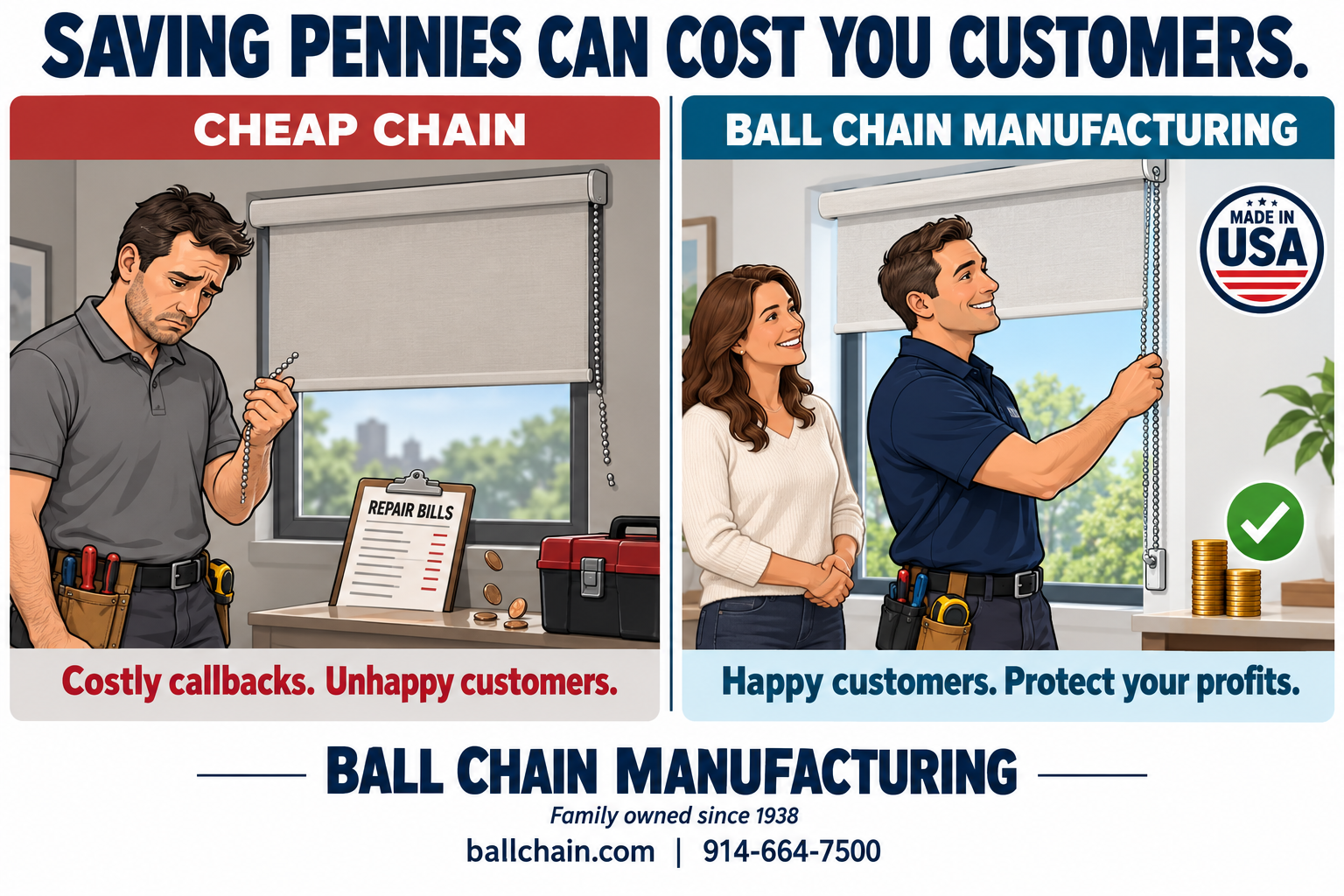
One roller shade manufacturer switched from our U.S.-made chain to a lower-priced chain supply from China. We had cautioned the company about chain quality before the switch. Months later, it was dealing with broken-chain complaints, increased warranty work, and furious customers.
Customers felt that the quality they had relied on had been sacrificed to save money. They were now dealing with repairs, frustrated end users, and damage to their own customer relationships.
One customer who contacted us reported that the Chinese chain was breaking, while the U.S.-made chain they had previously received had never caused that problem.
The frustration was serious enough that one customer said they would never buy from that shade supplier again. The consequences had reached beyond replacement parts and service calls to the loss of customer confidence and future business.
The manufacturer’s review also identified increased operating resistance from a change in chain routing, along with some installation errors. Its own comparative drop-and-abuse testing found that our U.S.-made chain resisted sudden loads and jarring impacts much better.
The manufacturer has since returned to using our U.S.-made chain exclusively for all its shade production.
How much do you really save on cheaper chain if it costs you a customer?
What does a broken chain really cost?
Consider everything involved in putting the problem right:
-
Scheduling a return visit and sending a technician.
-
Paying for travel, repair labor, replacement parts, and shipping.
-
Handling customer calls and warranty paperwork.
-
Taking time away from new installations and other paying work.
-
Rebuilding customer confidence and protecting future business.
For illustration: saving $0.50 per shade means one $150 service call wipes out the savings on 300 shades.
And that calculation does not put a dollar value on your reputation.
Our clear recommendation: high-grade 304 stainless steel.
For quality roller shade systems, our high-grade 304 stainless steel chain is our first choice.
Our high-strength #10 304 stainless steel chain offers tensile breaking strength exceeding 115 pounds—more than twice the published 45-pound average breaking strength of our standard #10 nickel-plated steel chain.
We also offer our new Super Strong Stainless Steel™ chain, with 135 lbs+ tensile breaking strength and limited elasticity. Ask us about the 304 stainless steel option for your shade application.
That combination of strength, corrosion resistance, and controlled stretch offers important advantages for demanding roller shade systems.
Roller shades are installed beside windows, where condensation, humidity, or moisture entering through an open window can expose the operating chain to conditions that are easy to overlook.
Hotels and other commercial properties add another consideration: frequent cleaning. Housekeeping staff may wipe chains with cleaning products, and chemical residues or inappropriate cleaners can increase corrosion risk.
Nickel-plated steel relies on its protective finish. If that finish wears or becomes damaged, the underlying carbon steel can be exposed and rust. 304 stainless steel’s corrosion resistance comes from the stainless steel itself. Compatible cleaning products and proper care help preserve that protection.
Nickel-plated steel may cost less upfront. For demanding roller shade applications, we recommend choosing the stronger, more corrosion-resistant stainless steel option.
“Stainless steel” alone does not tell you what you are buying.
I have seen chain promoted simply as “stainless steel,” with no grade identified, only to learn that it was a 400-series alloy.
The exact grade matters.
Some common 400-series stainless grades contain little or no nickel. Certain grades can be more susceptible to corrosion than 304 under demanding conditions. Their properties also differ, so you should never assume an unspecified stainless chain offers the same corrosion performance or finished-chain strength as the product you intended to buy.
The alloy grade, manufacturing process, and construction of the finished chain all affect performance.
A shiny appearance and a “stainless steel” description are not enough to establish quality.
Start asking your supplier:
-
What exact stainless steel grade am I buying?
-
Can you provide material documentation confirming that grade?
-
What is the tested breaking strength of the finished chain, and how was it measured?
-
Does its pitch consistently meet the specification for my clutch?
-
How much does it stretch, and is it suitable for my tension device?
DON’T BE FOOLED BY A GENERIC LABEL. BE INFORMED. START ASKING QUESTIONS.
A supplier should be able to explain and document the product it sells. If those answers are missing, you do not yet have the information needed to make a sound purchasing decision.
“#10 chain” is only part of the specification. Pitch matters.
Pitch is the spacing between the centers of adjacent balls. That spacing must match the clutch’s requirements so the chain engages correctly as the shade operates.
Different clutches can require different pitches—even when both use chain sold as “#10.”
For example, the following metal #10 chain applications use different ball counts:
| Clutch application | Chain specification |
|---|---|
| Rollease | 50–51 balls per foot |
| Louvolite | 48–49 balls per foot |
Confirm the required specification for the particular clutch model being used.
A chain may thread through a clutch and appear to work during installation even though its pitch is incorrect or inconsistent.
When the balls do not seat correctly in the clutch, uneven engagement or binding can increase operating resistance and place additional stress on the chain. With repeated use, that mismatch can contribute to premature wear and breakage.
A chain that appears to fit on installation day can still become a service problem later.
Consistency is just as important as the specified pitch. An acceptable average ball count does not establish that every section is properly spaced. The spacing needs to remain within the required tolerances throughout the chain.
An overseas factory’s assurance that it makes “#10 chain” does not demonstrate that it can consistently maintain the pitch your application requires. Your reseller or importer should be able to explain that distinction.
Tensile strength matters—and so does how it is measured.
A controlled tensile test secures the chain at opposite ends and applies an increasing pulling load along its length. The opposing forces place the chain in tension, and the test measures the maximum load it withstands before failure.
For chain, that breaking strength is commonly reported as a force in pounds or newtons. Meaningful comparisons require a defined, repeatable test method.
“It feels strong” is not a measured strength rating.
We have seen companies use unusual, improvised methods to judge chain strength. Pulling, jerking, or dropping a sample may show how it behaves in that particular situation, but those demonstrations do not establish a comparable tensile breaking-strength rating.
Properly designed impact and repeated-operation tests can provide additional information. They complement controlled tensile testing and evaluation of the complete shade system.
Correct pitch and adequate strength must work together. A strong chain with the wrong pitch can operate poorly. A correctly pitched chain with insufficient strength can still fail.
Limited elasticity provides another important advantage.
Our Super Strong Stainless Steel™ chain features limited elasticity, achieved through our proprietary manufacturing process.
This feature is engineered to minimize stretch and help maintain the chain’s intended operating length and tension.
That matters in modern shade systems using chain tension or tie-down devices. Excessive chain elongation can affect tension and contribute to operating problems, including stretch-related lockouts in compatible systems.
Our limited-elasticity chain is designed to help reduce that risk.
Selecting the appropriate chain, matching it to the clutch and tension device, and installing it correctly all contribute to reliable operation.
Made in the USA. Family owned since 1938.
We manufacture our U.S.-made roller shade chain in Mount Vernon, New York, with the manufacturing experience and direct support to help you select the right chain for your application.
Tell us which clutch you use, how the chain is routed, which tension device is installed, and what conditions the shade will face. We would be happy to discuss the appropriate material grade, pitch, strength, and elasticity for your system.
Protect your shades. Protect your margins. Protect your reputation.
Please share this with your owners and management team.
Please forward this email to your company’s owners, senior management, purchasing team, production managers, and quality-control staff.
Chain selection affects warranty costs, customer satisfaction, and the reputation attached to every shade you sell. The people responsible for those decisions should understand what is at stake.
I would be happy to discuss your application personally. Call me anytime on my cell: 914-720-3164.
Whether you have a question about pitch, stainless steel grades, tensile strength, tension devices, or a problem you are experiencing, I welcome the conversation.
Bill Taubner
President
Ball Chain Manufacturing Co., Inc.
Cell: 914-720-3164 — Call anytime
Office: 914-664-7500
Bill@ballchain.com
www.ballchain.com
A quality shade deserves a quality chain.